Elite Mind Architect
Brand site and digital platform for a high-performance coaching practice built on operating systems for humans, families, and businesses.
Elite Mind Architect is the coaching practice of Griffin Pierce — Navy veteran, performance coach, author, and systems builder. The site communicates a deep methodology for personal transformation and sells high-ticket coaching programs to founders, operators, and leaders. We built a brand-forward web experience that earns trust before it asks for a commitment.
Project at a Glance
- What: Brand site for a premium coaching practice with program pages, a book framework, and application-based funnels
- Who: Griffin Pierce — 10-year Navy veteran, 2,500+ hours of formal coaching education, co-founder of Temple Logiq
- Stack: Next.js, React, Tailwind CSS
- Status: Live at elitemindarchitect.com
The Challenge
Griffin Pierce had spent a decade in the Navy, years leading high-pressure sales teams, and thousands of hours studying movement, breathwork, nutrition, and performance coaching. He had a proven methodology — the Human Operating System — and a book manuscript, "The Captain & The Vessel." What he did not have was a digital presence that matched the depth of his work.
The typical coaching website was not going to work here. Most fall into one of two traps: either a generic template that looks like every other life-coach landing page, or an over-designed experience that obscures the actual offering. Griffin needed something different. The site had to:
- Communicate credibility and philosophy without sounding like a sales pitch
- Present programs ranging from $9,000 to $55,000 in a way that justified the investment before the visitor even applied
- Guide visitors through an application process rather than a checkout flow — because this is a partnership, not a transaction
- Showcase a book framework, a 17-week boot camp, and a year-long coaching container as distinct but connected offerings
The core tension was translating something deeply personal and experiential — breathwork, embodied leadership, sacred structure — into a web experience that felt authentic rather than performative.
The Approach
We anchored the design around Griffin's own language: "operate from signal, not noise." Every page needed to be intentional, with nothing that did not earn its place.
- Trust before transaction — no buy-now buttons anywhere on the site. Every path leads to an application, signaling exclusivity and filtering for aligned clients
- Photography as proof — Griffin's lifestyle photography (river adventures, coastal golf, skiing with family, professional portraits) does the work that testimonials usually do, showing a life that walks the talk
- Clear information hierarchy — multiple complex offerings (boot camp, bespoke coaching, book, three OS types) organized so a first-time visitor can orient within seconds
- Voice-consistent copy — the site reads like Griffin speaks: direct, grounded, occasionally irreverent ("Will I have to quit coffee, go vegan, or delete Instagram?")
What We Built
Homepage and Brand Identity
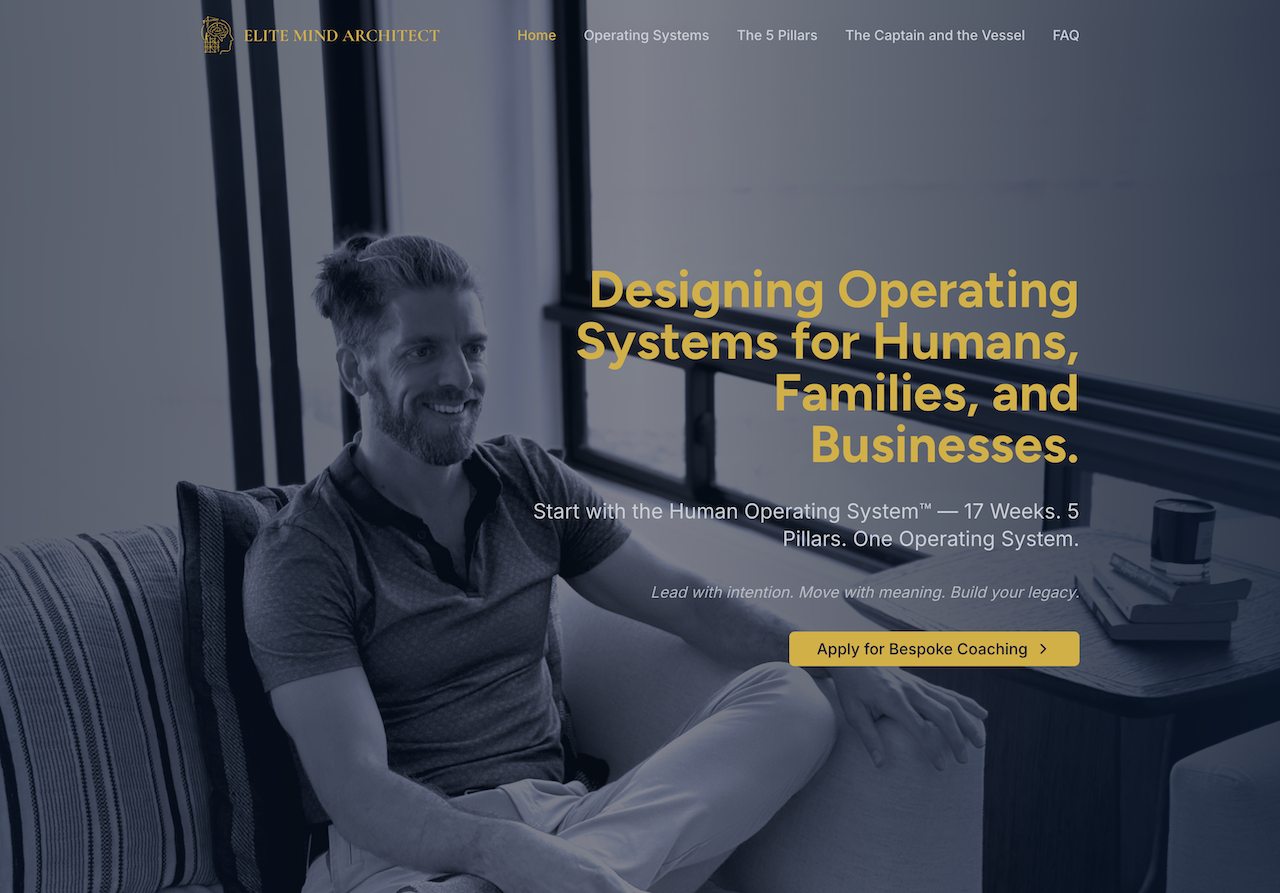
The homepage opens with a full-width hero featuring Griffin's portrait photography alongside the tagline: "Designing Operating Systems for Humans, Families, and Businesses." Below it, the About section tells Griffin's story — Navy, sales, yoga, Temple Logiq — in a way that establishes range without reading like a resume. Both primary CTAs route to the application flow.

Operating Systems Hub
The Operating Systems page serves as a routing layer between the three systems Griffin is building. The Human OS is live with a "Learn More" link; Family OS and Business OS are marked "Coming Soon." This page sets the long-term vision: EMA is not a single program, it is an ecosystem.
Human Operating System Boot Camp
This is the flagship offering page. It walks the visitor through:
- What this is — four program phases (Exploration, Adoption, Integration, Transition) across 17 weeks
- The toolkit — every participant receives kettlebells, a steel mace, pull-up bar, massage gun, foam roller, a leather-bound "Captain's Log" journal, and more
- The weekly rhythm — three live sessions plus four solo practice days, totaling 48 guided sessions and 64 solo practices
- Program arc — weeks broken into four phases with clear milestones
- Pricing tiers — Standard ($15,000), Vault Special ($12,000), and Founding Client ($9,000)
The page reads top-to-bottom like a conversation: here is what we do, here is what you get, here is what it costs, here is how to apply.
The Human Operating System is built on five pillars: Breath, Body, Mind, Nutrition, and Recovery. Each pillar has its own practices, and the 17-week program progressively layers them until the participant has a complete, self-sustaining system.
The Captain & The Vessel
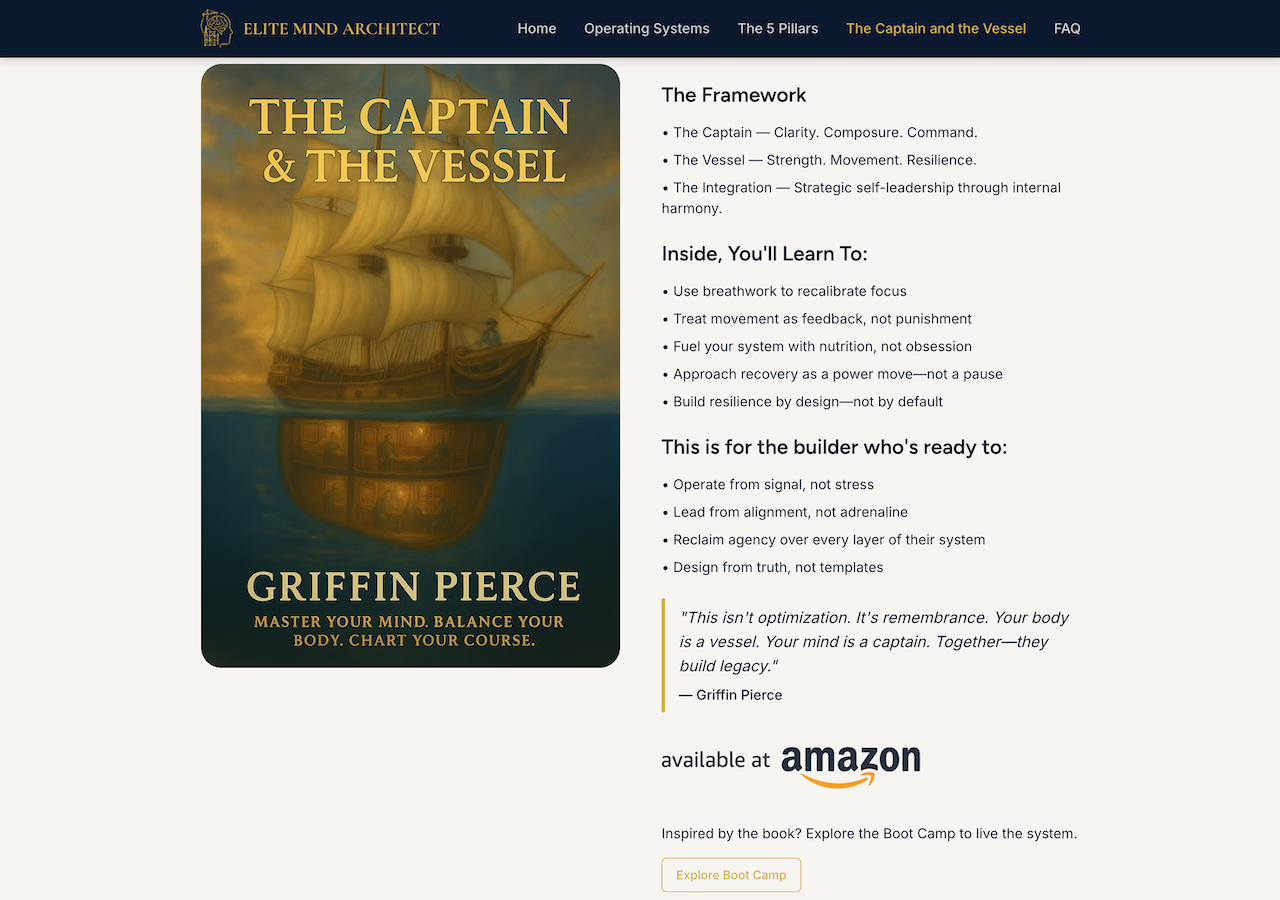
This page presents Griffin's book and its core framework. The metaphor — your mind is the captain, your body is the vessel, and together they build legacy — is broken into three sections: The Integration (strategic self-leadership), The Vessel (strength, movement, resilience), and The Captain (clarity, composure, command). The page connects the book's ideas directly to the boot camp, creating a natural reading-to-doing pipeline.
Bespoke Coaching
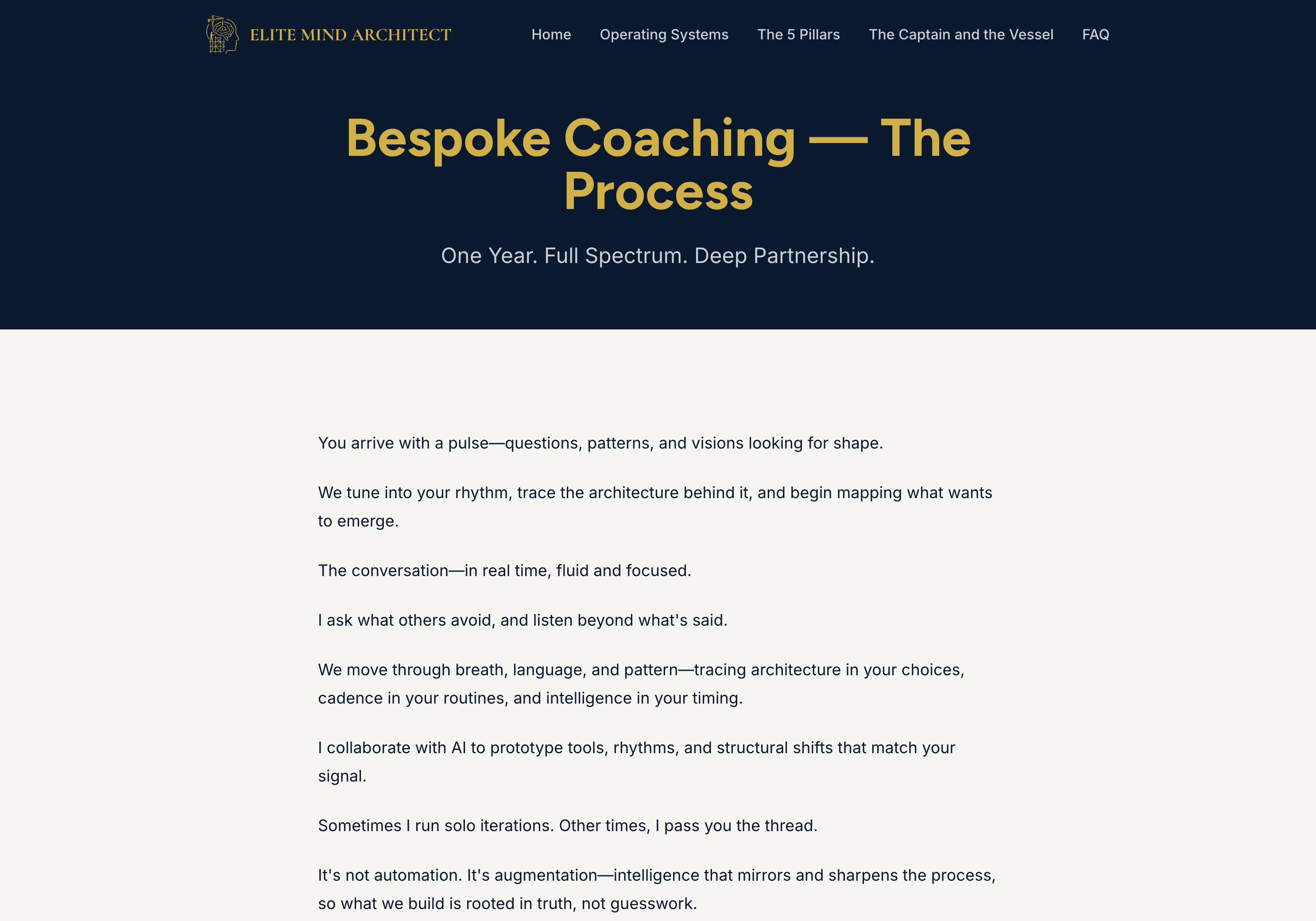
The highest-tier offering: a full-year partnership priced from $39,000 to $55,000. The page walks through how the engagement works — weekly coaching sessions, ongoing access, an expert network brought in as needed. That expert network includes software engineers, security engineers, marketing officers, and admin support, all coordinated under Griffin's guidance.
The copy makes a deliberate distinction: "You're not buying a program. You're stepping into a process." The application itself is positioned as a signal of readiness, not a formality.
FAQ
The FAQ page addresses objections head-on with Griffin's characteristic directness. Questions range from the practical ("What's the time commitment?") to the philosophical ("Is this where I become who I'm meant to be?") to the blunt ("Can I still smoke weed, eat steak, and skip meditation sometimes?"). The tone filters as much as it informs — if the voice resonates, the visitor is likely a fit.
Technical Highlights
Architecture
The site is built on Next.js for server-side rendering and fast page loads, with Tailwind CSS for responsive, utility-first styling. The design prioritizes large imagery, clean typography, and generous whitespace to match the premium positioning of the brand.
Key technical decisions:
- Image-heavy layout with performance — lifestyle photography is central to the brand, so we optimized with Next.js Image component for lazy loading, responsive sizing, and format selection
- Application funnels over checkout — form-based application flows rather than payment integrations, matching the high-touch sales model
- SEO and metadata — structured metadata across all pages so the site surfaces correctly for coaching and personal development queries
- Mobile-first responsive design — the audience includes busy founders checking the site between meetings; every page works cleanly on mobile without sacrificing the visual impact of the desktop layout
- Modular page architecture — each offering (boot camp, bespoke, book) is its own self-contained page, making it straightforward to add Family OS and Business OS pages as they launch
Outcome
Elite Mind Architect now has a digital presence that matches the depth and intentionality of Griffin's coaching methodology. The application-based funnels filter for serious, aligned clients before a conversation ever starts. The site's design language — clean, grounded, direct — carries the "lead with intention, move with meaning" philosophy into every page and interaction.
The architecture is built to grow. As Family OS and Business OS launch, the Operating Systems hub and modular page structure are ready to accommodate them without a redesign.
See the full experience at elitemindarchitect.com — from the Human Operating System Boot Camp to the Bespoke Coaching application.
Have a Similar Project in Mind?
Let's talk about how I can help bring your idea to life.